Recognizing common Toyota Prius wheel alignment symptoms usually starts with an off-center steering wheel, uneven tread wear, or the car pulling toward one side on flat pavement. When your wheels point at awkward angles, the tires drag against the asphalt instead of rolling freely. That drag strains the steering parts and quickly lowers your hybrid’s miles per gallon.
Toyota Prius wheel alignment symptoms: Common signs
A misaligned Prius shows distinct warnings before total tire failure happens. You’ll usually spot these clues during daily commuting or while parking:
- Steering wheel sits crooked: The steering emblem looks tilted left or right while the car travels straight forward.
- Car pulls to one side: If you relax your grip on a flat road, the car drifts toward the shoulder or oncoming lanes.
- Vibrations in the wheel: Shaking at highway speeds points to tracking errors or wheel balance issues.
- Loose or wandering feel: The car feels floaty, requiring constant steering corrections to stay centered.
- Squealing tires: Tires chirp or squeal while turning corners at ordinary city speeds.
Here is how these signs compare in severity:
| Symptom | Primary Cause | Immediate Risk | Action Needed |
|---|---|---|---|
| Off-center steering wheel | Uneven tie rod adjustment | High tire scrub | Align within two weeks |
| Side pulling | Unequal camber or caster | Driver fatigue | Check tire pressure first |
| High-speed shudder | Uneven toe angle or wheel balance | Suspension bush wear | Inspect suspension links |
| Tire chirping on turns | Severe toe-in or toe-out | Rapid tread loss | Align immediately |
Why hybrid vehicle suspension requires specific attention
Hybrid cars carry extra weight compared to standard gas-only compacts. The Prius holds a high-voltage traction battery pack over or just ahead of the rear axle. That added mass changes how the car responds to bumps and road dips.
Because of this constant rear load, the rear springs and bushings compress more over time. If you install heavy cargo or carry rear passengers daily, the rear ride height drops slightly. This alters the rear toe and camber angles. When the rear suspension shifts out of spec, it pushes the front end sideways. That effect forces the driver to steer against the rear thrust angle, which creates uneven drag across all four corners.
How uneven tire wear indicates alignment issues
Tires show clear physical evidence when the wheels don’t track straight. Rubbing a bare hand carefully across the rubber tread reveals problems before your eyes can see them.
Identifying feathering and camber wear patterns
Feathering happens when the toe angle is incorrect. Each tread block wears down smoothly on one side while staying sharp and raised on the other. If you run your hand across the tread inward and feel sharp edges, the tire is toeing in too much. If it feels sharp sliding outward, it’s toeing out.
Camber wear looks different. It destroys only the inside edge or outside edge of the tire. Negative camber tilts the top of the wheel inward, which grinds away the inside shoulder. If you notice inside edge wear on your Prius, check the front lower control arms or rear axle beam for damage.
The impact of tire pressure on Prius handling
Underinflated tires mimic alignment problems. Low pressure softens the sidewalls, making the car pull toward the softer side and wander on the highway. Maintaining correct tire pressure helps protect your tread and suspension components. According to the NHTSA tire safety guide, properly inflated tires run cooler, last longer, and handle road hazards with less risk of sudden failure.
Check pressures when the tires are cold. A tire that’s 5 PSI low can cause pulling that feels like bent hardware. If fixing the air pressure stops the drift, your metal components are likely fine.
The role of steering sensor calibration in hybrid models
Modern Prius generations rely on an electronic steering angle sensor located behind the steering wheel. This sensor tells the vehicle stability control computer exactly where the driver wants to go.
If a mechanic straightens the wheels mechanically but skips the electronic zero-point calibration, the car’s computer gets confused. The computer thinks you’re turning when you’re driving straight. This mistake can cause phantom traction control interventions, where the car cuts power or taps an individual brake during ordinary cruising. If a shop offers an alignment without steering sensor calibration, walk away.
How road conditions and driving habits affect alignment
Alignment shifts slowly through normal road use, but sharp impacts knock parts out of spec instantly:
- Potholes and frost heaves: Striking deep road holes forces the wheel upward and backward, bending tie rods or strut housings.
- Curb impacts while parking: Tapping curbs while parallel parking slowly knocks front toe settings out of range.
- Railroad crossings: Crossing tracks at high speeds hammers the suspension bushings and loosens eccentric adjustment bolts.
- Worn ball joints: Rubber bushings dry out, crack, and create slack that prevents the wheels from holding any alignment angle.
Steps to check your vehicle alignment at home
This inspection is for drivers who want to check for obvious mechanical issues in their driveway. This is NOT for cars that recently suffered a heavy crash, which need a frame rack inspection.
- Park on level ground: Place the car on a flat concrete pad, set the parking brake, and keep the steering wheel centered.
- Inspect tire wear: Turn the front wheels fully to the right. Look closely at the inner and outer shoulders of both front tires for thinning tread or exposed cords. Repeat with the wheels turned left.
- Run the palm test: Slide your flat palm sideways across the tread ribs. If the rubber catches on your skin like saw teeth in one direction, your toe angle is out of spec.
- Take a string line measurement: Tie a thin piece of bright mason line around all four tires at hub height. Pull the string tight against the sidewalls. If the string touches the rear of a front tire but leaves a wide gap at the front edge, the toe angle is noticeably off.
- Perform a flat-road tracking check: Drive at 40 mph on an empty, flat parking lot or road crown. Release hand pressure on the wheel for three seconds. If the vehicle veers sharply instead of tracking straight, your alignment needs service.
When to seek professional suspension service
Home checks only tell you that a problem exists. You can’t set modern computer-guided alignment specs using basic hand tools on your driveway.
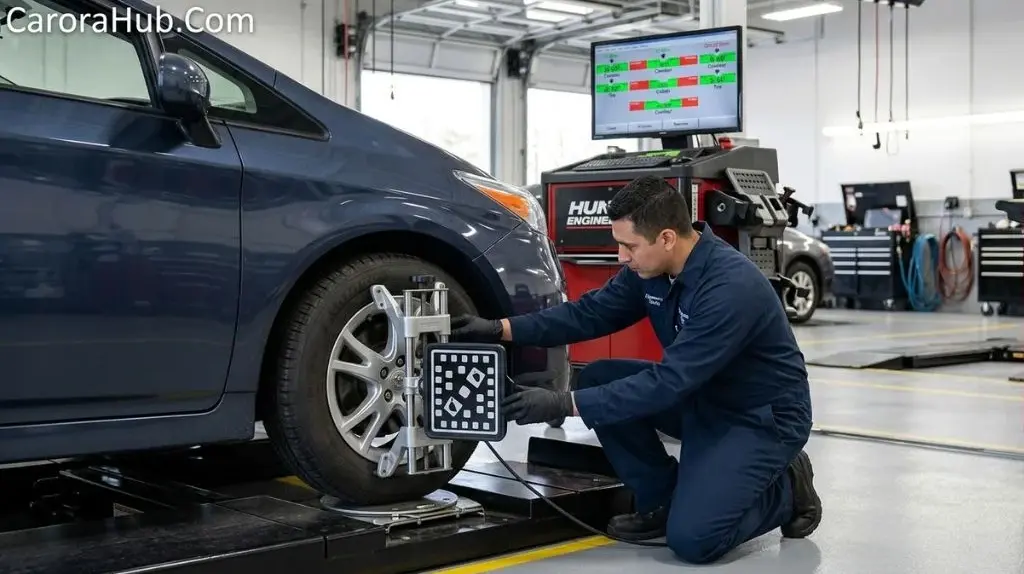
Take the car to a licensed alignment shop if you feel deep thumps over bumps, see metal belts showing through the tire rubber, or notice stability control warning lights. A trained technician uses laser targets clamped to each wheel to measure caster, camber, and toe within tenths of a degree. This precision varies by model year—check the chassis label inside your driver door jamb for the exact curb weight and wheel size specs the tech needs.
A common mistake drivers make is delaying alignment service to save money. Skipping a basic alignment service often ruins two front tires within a few months, forcing you to pay for new tires on top of the original repair.
Frequently Asked Questions Of Toyota Prius Wheel Alignment Symptoms
Does a wheel alignment improve fuel efficiency in a Prius?
Yes. When wheels point at odd angles, the tires drag sideways across the road surface. This drag creates rolling resistance that forces the hybrid gas engine to run longer and recharge the battery more frequently. Fixing alignment issues restores smooth rolling motion and brings fuel mileage back to its expected numbers.
How often should I have my alignment checked on a hybrid?
Have the alignment checked regularly. You should also check it immediately whenever you buy a new set of tires, hit a large road hazard, or replace steering parts like tie rods or struts.
Can a bad alignment trigger dashboard warning lights?
Yes. If the alignment causes the steering wheel to sit crooked while the car moves straight, the steering angle sensor conflicts with the yaw rate sensor. This disagreement prompts the car’s computer to illuminate the amber ABS or stability control warning lights.
Is a four-wheel alignment necessary for a front-wheel drive Prius?
Yes. While the Prius sends engine power only to the front wheels, the rear wheels dictate the vehicle’s thrust line. If the rear suspension is crooked, the back of the car pushes sideways. That forces you to turn the front wheels just to keep the car going straight. A professional four-wheel alignment keeps all four tires traveling along the same exact path.

I am Julian Drive, an automotive enthusiast and repair expert with over 7 years of hands-on experience in vehicle maintenance. At Carora Hub, I simplify complex car issues into easy-to-follow DIY guides to help drivers stay safe and save on repair costs.