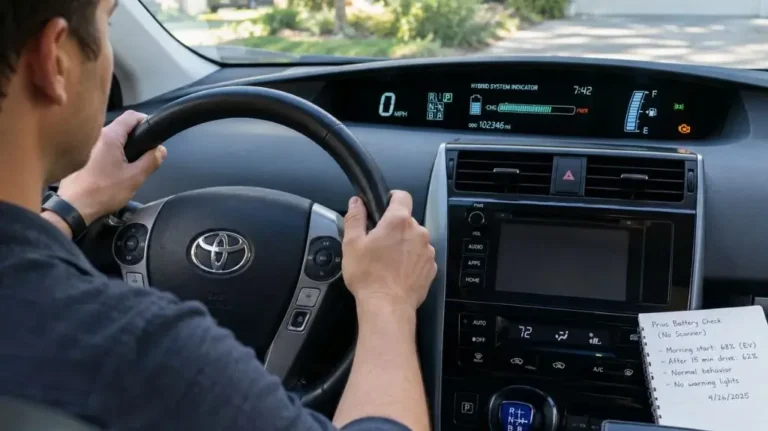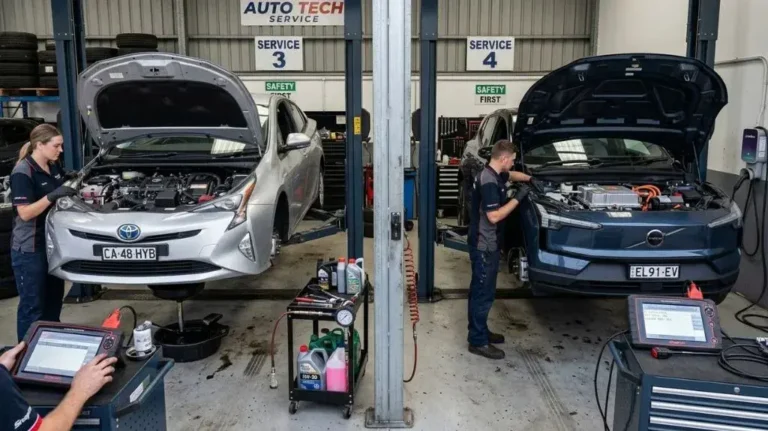
A Toyota Prius inverter manages hybrid power, while a regular car alternator charges the 12-volt battery.
Understanding the Toyota Prius inverter vs regular car alternator comparison helps explain why Prius charging problems can look unusual. After working through many hybrid system questions, I have found that the biggest mistake is treating the Prius inverter like a belt-driven alternator. This guide explains how both systems work, what fails, how much repairs may cost, and which warning signs deserve quick attention.
Toyota Prius inverter vs regular car alternator: The basic difference
The Toyota Prius inverter and a regular car alternator do different jobs. A regular alternator creates electricity for the car’s 12-volt system. The Prius inverter controls electricity between the high-voltage battery, electric motors, and other hybrid parts.
A simple way to picture the systems is this:
• A regular alternator is like a small power plant turned by an engine belt.
• A Prius inverter is like a power traffic controller. It changes voltage and current, then sends power where the hybrid system needs it.
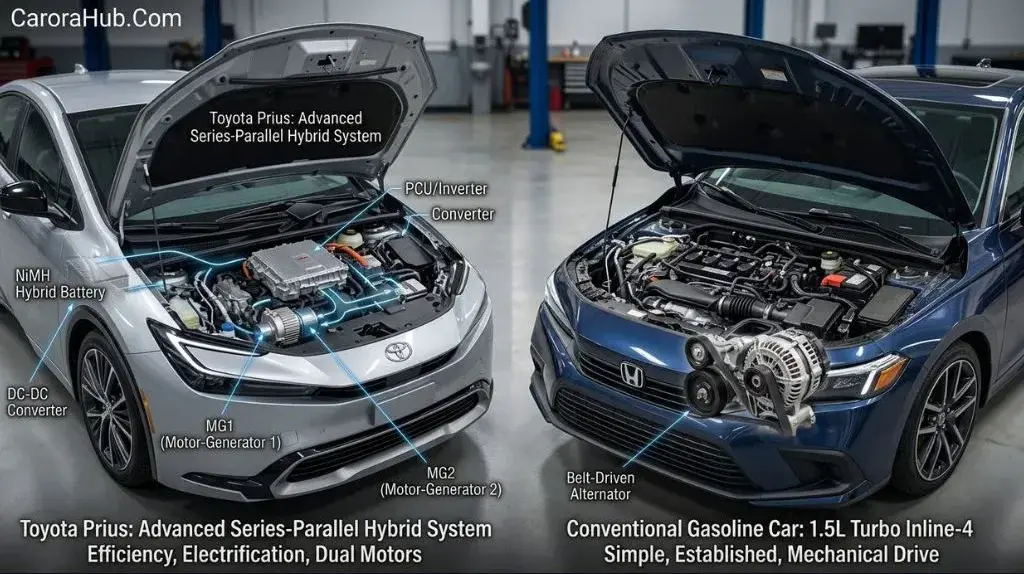
The Toyota Prius inverter is part of the hybrid power control system. It works with motor-generators called MG1 and MG2. These motor-generators can produce electricity, use electricity, or help start the gasoline engine.
A regular car alternator usually connects to the engine with a serpentine belt. When the engine runs, the belt spins the alternator. The alternator produces alternating current, or AC, and built-in diodes change it into direct current, or DC.
The Prius does not normally use a belt-driven alternator to charge its 12-volt battery. Instead, a DC-to-DC converter inside or near the inverter assembly reduces high-voltage battery power to about 12 to 14 volts. That lower voltage runs the 12-volt accessories and charges the small 12-volt battery.
What does a Toyota Prius inverter do?
The Toyota Prius inverter changes electrical power from one form to another. This job is vital because the hybrid battery stores DC power, while the electric drive motors use controlled three-phase AC power.
The inverter can perform several tasks:
• It changes high-voltage DC from the hybrid battery into AC for the drive motor.
• It changes AC from the motor-generator into DC during regenerative braking.
• It helps send power back to the hybrid battery.
• It supports the DC-to-DC converter that supplies the 12-volt electrical system.
• It helps control motor speed and torque.
The inverter does not simply “make electricity” in the same way as a regular alternator. It manages power flow with computer-controlled switching devices. These devices must react in fractions of a second as the car accelerates, slows, climbs a hill, or starts the gasoline engine.
Most Prius inverter assemblies use power electronics such as insulated-gate bipolar transistors, often called IGBTs. These parts switch high-voltage current rapidly. Cooling passages and special coolant help control heat.
This is why the Toyota Prius inverter vs regular car alternator comparison is more complex than comparing two charging units. The Prius inverter is both a power converter and a key part of the hybrid drive system.
How a regular car alternator works
A regular alternator uses mechanical energy from the gasoline or diesel engine. A belt spins a rotor inside the alternator. The spinning magnetic field creates AC electricity in the stator windings.
The alternator then uses rectifier diodes to turn AC into DC. A voltage regulator controls output so the car’s battery and electronics receive safe voltage.
A typical alternator supports:
• The 12-volt battery
• Headlights and interior lights
• The engine control unit
• Fuel pumps and ignition parts
• Audio, climate, and safety systems
• Heated seats, windows, and other accessories
The alternator works only when the engine turns it. If the belt breaks, the alternator stops charging. A failed alternator can leave the car running for a short time, but the battery will eventually lose power.
Common regular alternator problems include:
• Worn brushes or slip rings
• Failed diodes
• A bad voltage regulator
• Damaged bearings
• Loose or broken belt
• Corroded battery cables
A charging warning light often appears when the alternator output drops. Still, the warning light does not prove that the alternator itself is bad. A weak battery, poor ground, wiring fault, or belt issue can create similar symptoms.
How the Prius charging system works
The Prius uses two main electrical systems. The first is the high-voltage hybrid system. The second is the low-voltage 12-volt system.
The high-voltage system powers the electric motors and helps start the gasoline engine. Depending on the Prius generation, the battery pack may operate at several hundred volts.
The 12-volt system powers computers, lights, locks, relays, and other normal vehicle equipment. It also wakes up the hybrid control system when you press the Power button.
The charging path usually works like this:
The hybrid battery stores high-voltage DC power.
The inverter and DC-to-DC converter reduce that power to low-voltage DC.
The low-voltage power runs the vehicle electronics.
Extra low-voltage power charges the 12-volt battery.
The hybrid control computer adjusts output as electrical demand changes.
This design means the gasoline engine does not need to spin a separate alternator to charge the 12-volt battery. The engine may still run to charge the hybrid battery or provide mechanical power, but that is different from directly turning an alternator.
The Toyota Prius inverter vs regular car alternator difference becomes clear here. In a conventional car, engine speed directly affects alternator speed. In a Prius, electronic controls manage 12-volt charging through the high-voltage system.
Toyota Prius inverter vs regular car alternator comparison table
| Feature | Toyota Prius inverter system | Regular car alternator |
|---|---|---|
| Main power source | High-voltage hybrid battery and motor-generators | Gasoline or diesel engine |
| Mechanical belt required | Usually no belt-driven alternator | Yes, normally |
| Main output role | Converts and manages high-voltage and low-voltage power | Charges the 12-volt battery |
| Motor connection | Controls electric drive motors | No direct drive motor control |
| 12-volt battery charging | DC-to-DC converter | Alternator and voltage regulator |
| Power conversion | DC to AC, AC to DC, and high-voltage DC to low-voltage DC | AC to DC |
| Cooling needs | Often liquid-cooled | Usually air-cooled |
| Repair risk | High-voltage safety concerns | Mostly low-voltage concerns |
| Common warning signs | Hybrid warning, “Check Hybrid System,” loss of power | Battery warning light, dim lights |
| Typical diagnosis | Scan tools and hybrid testing are often needed | Voltage and current tests are often enough |
The table shows why the Toyota Prius inverter cannot be tested like a standard alternator. A basic voltage check is useful, but it may not find an inverter fault.
Does a Prius have an alternator?
Most Toyota Prius models do not have a conventional belt-driven alternator. The inverter assembly includes a DC-to-DC converter that performs the 12-volt charging job.
Some people call this converter the “Prius alternator” because it replaces the alternator’s charging function. That description may help in casual conversation, but it is not technically correct.
The Prius may also generate electricity through MG1 and MG2. MG1 can help start the gasoline engine and produce electrical power. MG2 provides most of the electric drive force and also produces electricity during regenerative braking.
These motor-generators are not alternators in the normal repair sense. They are part of the hybrid transaxle and work under commands from the inverter and hybrid control computers.
This distinction matters when ordering parts. Searching for a regular alternator for a Prius can lead to the wrong component. Search terms such as “Prius inverter assembly,” “DC-to-DC converter,” or “hybrid inverter” are usually more accurate.
Toyota Prius inverter vs regular car alternator failure symptoms
The symptoms can overlap, but the warning signs are often different.
A regular alternator may fail in these ways:
• Battery warning light turns on
• Headlights become dim
• The engine cranks slowly
• Accessories work poorly
• The vehicle stalls after battery power runs out
• A whining or grinding sound comes from the alternator
A Prius inverter or DC-to-DC converter problem may cause:
• “Check Hybrid System” warning
• Red triangle warning light
• Multiple dashboard warnings
• Reduced power or limp mode
• A discharged 12-volt battery
• Trouble entering READY mode
• Sudden loss of electric drive support
• Inverter coolant overheating warnings
A weak Prius 12-volt battery can also create many warning lights. This is one of the most common diagnostic traps. A small battery with low voltage may cause computers to communicate poorly, which can make the car appear to have a major hybrid failure.
A good first step is to test the 12-volt battery after the car has been off for several hours. A healthy, fully charged 12-volt battery often measures close to 12.6 volts at rest. Around 12.2 volts suggests a low state of charge, while a much lower reading may indicate a weak or discharged battery. These values are general guides, not a final diagnosis.
Do not assume every warning light means the inverter has failed. Proper scan data and system testing matter.
How to test a Prius inverter charging system
Testing the Toyota Prius inverter requires more care than testing a regular alternator. The high-voltage system can cause severe injury or death. Only trained technicians with the correct insulated tools and safety equipment should open or disconnect high-voltage components.
A safe basic check for an owner is to inspect the 12-volt charging voltage while the Prius is in READY mode. Depending on the model and electrical load, voltage may often remain near the mid-13-volt to mid-14-volt range.
Use these steps:
Turn off lights, climate control, and accessories.
Measure the 12-volt battery with the vehicle off.
Start the Prius and confirm that the dashboard shows READY.
Measure voltage again at the 12-volt battery.
Turn on headlights and the blower, then observe the voltage.
Scan for trouble codes with a tool that can read hybrid control modules.
A voltage reading alone does not prove that the inverter is healthy. The vehicle may charge at the battery but still have a cooling problem, isolation fault, communication issue, or intermittent inverter fault.
A professional diagnosis may include:
• Hybrid control module codes
• Inverter temperature data
• Coolant pump operation
• High-voltage isolation testing
• DC-to-DC converter output
• Cable and connector inspection
• Battery block voltage data
• Road testing under controlled conditions
Never probe orange high-voltage cables with an ordinary multimeter. The orange color warns that the circuit can carry dangerous voltage.
Common causes of Prius inverter failure
The inverter is designed to last a long time, but it is not immune to heat, age, or electrical stress.
Common causes include:
• Failed inverter coolant pump
• Low or contaminated inverter coolant
• Blocked coolant passages
• Excessive heat
• Internal IGBT damage
• Electrical short circuits
• Water intrusion
• Damaged connectors
• Incorrect jump-start procedures
• Software or communication faults
A failed inverter coolant pump is especially important. If coolant does not circulate, inverter temperatures can rise quickly. Some Prius models have had service campaigns or warranty extensions related to inverter concerns, so owners should check vehicle history and manufacturer records by VIN.
Jump-start mistakes can also damage hybrid electronics. Connecting cables backward, using an incorrect booster source, or creating a voltage spike may harm fuses, computers, or the DC-to-DC converter.
One practical lesson is simple: always confirm positive and negative connections before jump-starting a Prius. Take a moment to read the under-hood labels. That small pause can prevent a very large repair bill.
Common causes of regular alternator failure
Regular alternators face different stresses. They live in a hot engine bay and spin whenever the engine runs.
Typical failure causes include:
• Worn internal brushes
• Failed voltage regulator
• Bad rectifier diode
• Bearing wear
• Oil or coolant contamination
• Loose belt tension
• Damaged wiring
• Excessive accessory load
• A weak battery that makes the alternator work harder
A failing alternator may produce a grinding sound, a burning smell, or a high-pitched whine. The battery light may flicker before the alternator stops working completely.
Unlike many Prius inverter problems, regular alternator repairs are often easier to confirm. A technician can measure charging voltage, inspect belt condition, and perform a current output test.
Still, replacing an alternator without testing the wiring and battery can waste money. A damaged cable or poor ground can create the same low-voltage symptoms.
Toyota Prius inverter vs regular car alternator repair cost
Repair costs vary by model year, location, part quality, and labor rate. A regular alternator replacement is usually more predictable. The part is common, access is familiar, and many independent repair shops can complete the job.
Prius inverter repairs can cost more because:
• The part contains complex power electronics.
• Hybrid safety procedures require special training.
• Some assemblies include multiple functions.
• Diagnosis may require a factory-level scan tool.
• New replacement units can be expensive.
• Coolant bleeding and software checks may be needed.
A used Prius inverter may reduce the parts cost, but it brings risk. The replacement must match the correct part number and vehicle generation. A used unit may also have unknown heat exposure or a hidden internal fault.
A remanufactured inverter can be a middle option. Ask about testing, warranty length, return terms, and whether the unit includes the correct DC-to-DC converter section.
The most important cost-saving step is accurate diagnosis. Replacing the inverter when the real problem is a weak 12-volt battery, blown fuse, coolant pump, or damaged cable can turn a small repair into a major one.
Can a regular alternator replace a Prius inverter?
No. A regular alternator cannot replace a Prius inverter.
The inverter controls high-voltage power for the electric motors. It also supports regenerative braking and low-voltage charging. A conventional alternator cannot perform these tasks.
Adding an alternator would not solve a Prius inverter fault. It could also create serious wiring, control, cooling, and safety problems.
The Toyota Prius inverter vs regular car alternator comparison is not a case of choosing one part over the other. They belong to different vehicle designs. A normal car uses an alternator because its engine provides the main source of mechanical power. A Prius uses hybrid electronics because it combines engine power, battery power, and electric motor control.
Maintenance tips for both systems
Good maintenance reduces charging problems in both hybrid and conventional vehicles.
For a Prius:
• Keep the 12-volt battery in good condition.
• Check inverter coolant level and condition.
• Confirm that the inverter coolant pump circulates fluid.
• Keep cooling vents clear, especially the hybrid battery intake.
• Use the correct jump-start points.
• Scan warning codes early.
• Do not ignore a red triangle or hybrid system warning.
• Have high-voltage work done by a trained technician.
For a regular car:
• Inspect the serpentine belt.
• Check battery terminals for corrosion.
• Test the alternator when battery symptoms appear.
• Inspect engine grounds and charging cables.
• Replace a weak battery before it overloads the alternator.
• Listen for unusual belt or bearing noise.
In my experience, owners often wait because the car still starts. That can be risky. Charging faults tend to become worse, not better. Early testing usually gives you more repair choices.
Mistakes to avoid when diagnosing charging problems
The most common mistake is replacing a part based on one voltage reading. Voltage is useful, but it does not show the complete health of a charging system.
Avoid these errors:
• Calling every Prius charging part an alternator
• Replacing the inverter before testing the 12-volt battery
• Ignoring inverter coolant flow
• Using a basic code reader that cannot access hybrid modules
• Probing orange high-voltage cables
• Installing a used inverter without checking compatibility
• Jump-starting without confirming polarity
• Assuming a dashboard warning identifies one failed part
A second mistake is confusing the hybrid battery with the 12-volt battery. The hybrid battery powers the electric drive system. The 12-volt battery wakes up the computers and runs standard vehicle electronics.
The two batteries work together, but they are not interchangeable. A weak 12-volt battery can prevent the hybrid system from turning on, even when the high-voltage battery is healthy.
Which system is more efficient?
The Prius system is generally more efficient because it can recover energy during braking and use electric power at low speeds. Its inverter helps control that energy flow with great precision.
A regular alternator has a simpler design, but it creates an extra load on the engine. The engine must burn fuel to spin the alternator. The alternator also loses energy during AC generation, rectification, and voltage regulation.
The Prius avoids some of that mechanical loss by using motor-generators and electronic power control. During regenerative braking, the drive motor acts as a generator. It turns some of the car’s motion into electrical energy instead of wasting all of it as heat through the brake pads.
Efficiency does not mean the Prius system is easier or cheaper to repair. It means the system uses more advanced hardware and software to reduce energy waste.
Why the Toyota Prius inverter matters to hybrid driving
The inverter gives the Prius its smooth and quiet driving feel. It controls how much electric torque reaches the drive wheels. It also helps blend gasoline engine power with electric motor power.
When you press the accelerator, the inverter responds to requests from the hybrid control computer. It sends the correct current and frequency to the motor. When you lift off the accelerator or press the brake, it reverses the energy flow and helps recharge the hybrid battery.
This process happens without the driver needing to manage gears or charging controls. The inverter works quietly in the background, much like an air traffic controller guiding many planes at once.
That role makes the Toyota Prius inverter vs regular car alternator distinction important for owners, buyers, and technicians. The Prius inverter is not just a replacement for an alternator. It is central to the vehicle’s performance.
Frequently Asked Questions of Toyota Prius inverter vs regular car alternator
Does a Toyota Prius have a regular alternator?
Most Toyota Prius models do not use a belt-driven alternator. A DC-to-DC converter in the hybrid power system charges the 12-volt battery instead.
What charges the 12-volt battery in a Prius?
The DC-to-DC converter reduces high-voltage battery power to low-voltage power. That output runs the 12-volt electrical system and charges the 12-volt battery while the vehicle is in READY mode.
Can a bad Prius inverter drain the 12-volt battery?
Yes. A failed DC-to-DC converter section can stop the 12-volt battery from charging. However, a weak battery, bad cable, fuse, or wiring fault can cause similar symptoms.
Is the Toyota Prius inverter dangerous to repair?
Yes. The inverter connects to the high-voltage hybrid system, which can cause serious injury or death. High-voltage diagnosis and repair should be handled by a trained technician with proper safety equipment.
How can I tell whether my Prius inverter is failing?
Possible signs include a hybrid warning, reduced power, several dashboard lights, inverter overheating messages, or a 12-volt battery that does not charge in READY mode. A full diagnosis requires hybrid-capable scan equipment and electrical testing.
Can I install a regular alternator in a Prius?
No. A regular alternator cannot control the electric drive motors, regenerative braking, or high-voltage power flow. It is not a functional replacement for the Prius inverter.
Is a Prius inverter the same as a hybrid battery?
No. The hybrid battery stores high-voltage electrical energy. The inverter converts and controls that energy for the motors and other vehicle systems.
Is an inverter repair cheaper than inverter replacement?
It can be, but the answer depends on the failed part and available parts. A coolant pump, fuse, connector, or wiring repair may cost much less than replacing the complete inverter assembly.
Conclusion
The Toyota Prius inverter vs regular car alternator comparison comes down to two different vehicle designs. A regular alternator uses engine belt power to charge a 12-volt battery, while the Prius inverter manages high-voltage power, electric motors, regenerative braking, and 12-volt charging through a DC-to-DC converter.
Do not diagnose a Prius like a conventional car. Start with the 12-volt battery, scan for hybrid codes, check coolant flow, and use qualified help for high-voltage work. If you are facing a warning light or charging problem, get an accurate diagnosis before buying an expensive part, and share your Prius experience or question in the comments.

I am Julian Drive, an automotive enthusiast and repair expert with over 7 years of hands-on experience in vehicle maintenance. At Carora Hub, I simplify complex car issues into easy-to-follow DIY guides to help drivers stay safe and save on repair costs.