For drivers in the United States, a Toyota Prius usually uses much less fuel than a similar nonhybrid gasoline car. A current Prius can reach about 57 mpg combined, while efficient compact gasoline cars often reach about 35–36 mpg combined. That difference can save roughly 200 gallons of gasoline every 15,000 miles, depending on the exact models, driving mix, fuel prices, and weather.
The Prius does not save fuel because of one feature alone. Its gas engine, electric motor, battery, regenerative braking, and automatic engine controls work as one system. The biggest gains often appear in city traffic, where a regular gas car wastes more energy during stops and low-speed driving.
This guide compares Toyota Prius fuel economy with that of regular gasoline cars sold in the United States. It also shows how to estimate fuel cost, where the Prius has the largest advantage, and when a nonhybrid may still make more sense.

Prius vs. gas car fuel economy at a glance
The Prius generally wins on fuel economy, but the size of the win depends on the comparison. A Prius should be compared with a similar vehicle, not with a large SUV or a small economy car.
The table below uses EPA combined ratings for representative U.S. models. Exact figures can change by model year, trim, drivetrain, wheel size, and equipment.
| Vehicle type | Representative EPA combined rating | Approximate gallons used per 15,000 miles |
|---|---|---|
| Toyota Prius LE, front-wheel drive | 57 mpg | 263 gallons |
| Toyota Prius, higher trim or larger wheels | About 52 mpg | 288 gallons |
| Efficient compact gasoline sedan | About 35–36 mpg | 417–429 gallons |
| Small gasoline SUV | About 28–32 mpg | 469–536 gallons |
| Midsize gasoline sedan | About 28–34 mpg | 441–536 gallons |
| Large gasoline SUV | Often below 25 mpg | More than 600 gallons |
The gallon figures use this simple formula:
Annual gallons used = annual miles ÷ combined mpg
A 57-mpg Prius driven 15,000 miles would use about 263 gallons. A 36-mpg gasoline car would use about 417 gallons. The difference is about 154 gallons per year, not 200, for those two ratings.
The Prius advantage becomes larger when the alternative is a heavier vehicle. It becomes smaller when the alternative is a very efficient compact gasoline car driven mostly on the highway.
Why the EPA combined number matters
The EPA combined rating is a weighted estimate based on city and highway testing. It gives a useful starting point, but it is not a promise of the exact number each driver will see.
Real fuel economy can change because of:
- Speed and traffic
- Cold weather
- Hills and strong wind
- Tire pressure
- Passenger and cargo weight
- Air-conditioning or heater use
- Short trips
- Driving style
- Roof racks and other accessories
- Fuel blend and road conditions
Use EPA figures to compare vehicles under the same test system. Use your own fuel records to measure your actual cost.
Why the Toyota Prius uses less fuel
The Prius saves fuel by reducing the work done by its gasoline engine. It can also recover some energy that a regular car normally loses as heat when braking.
A standard gasoline car sends power from its engine through a transmission to the wheels. When the driver brakes, much of the car’s motion becomes heat in the brake pads and rotors. The car cannot normally reuse that energy.
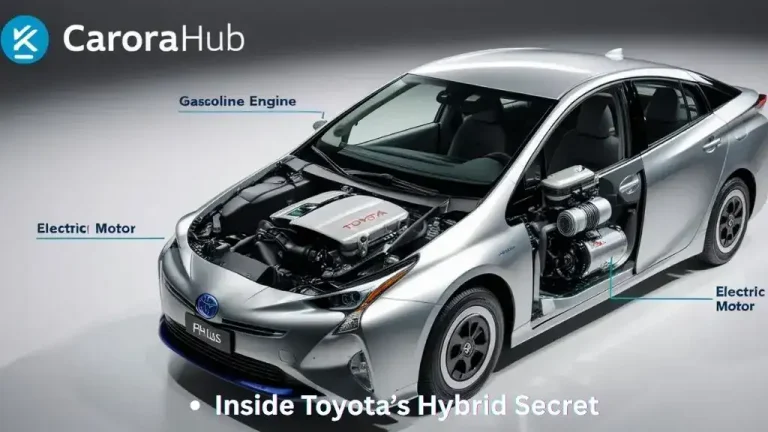
A Prius uses a hybrid system. Its electric motor can help move the car, and its generator can send some braking energy back to the battery. This process is called regenerative braking.
The Prius also has several other fuel-saving traits:
- The engine can shut off while stopped.
- The electric motor can move the car at low speeds in some conditions.
- The engine can run near efficient operating points.
- The system can blend engine and electric power without driver action.
- The car avoids much of the fuel waste linked to repeated starts and stops.
Think of a regular car as throwing away energy each time it slows down. The Prius acts more like a bucket that catches part of that energy and uses it later.
Why city driving favors the Prius
Hybrid systems often show their greatest benefit in city driving. Urban trips include many stops, starts, and periods of low-speed travel. These are conditions where regenerative braking and engine shutoff can reduce fuel use.
A regular gas car may idle at a red light or use fuel during repeated low-speed acceleration. A Prius can shut its engine off and use electric assistance during parts of this cycle.
The advantage is not unlimited. Hard acceleration, heavy traffic, cold starts, and aggressive climate-control use can still reduce Prius fuel economy.
Why highway driving narrows the gap
At steady highway speed, both cars must push through air resistance. The gasoline engine in a nonhybrid car may also run near a fairly efficient load. As a result, the Prius advantage often becomes smaller than it is in town.
A Prius can still benefit from its aerodynamic shape and efficient powertrain on the highway. However, a driver who travels long distances at 75 or 80 mph may not reach the EPA rating. Higher speed creates much more air drag.
A real-world fuel cost comparison
Fuel economy matters because it changes how often a driver buys gasoline. The easiest way to compare costs is to use the same mileage and fuel price for both cars.
Example: Prius vs. a 36-mpg gasoline car
Assume:
- Annual driving: 15,000 miles
- Prius fuel economy: 57 mpg
- Regular gasoline car fuel economy: 36 mpg
- Gasoline price: $3.50 per gallon
| Calculation | Toyota Prius | 36-mpg gas car |
|---|---|---|
| Miles driven | 15,000 | 15,000 |
| Fuel economy | 57 mpg | 36 mpg |
| Gallons used | 263 | 417 |
| Annual fuel cost | About $921 | About $1,458 |
| Approximate annual difference | About $537 |
The calculation is:
- Prius: 15,000 ÷ 57 = about 263 gallons
- Gas car: 15,000 ÷ 36 = about 417 gallons
- Difference: about 154 gallons
- 154 × $3.50 = about $539
This is a hypothetical estimate, not a guarantee. If gas costs $4.50 per gallon, the same fuel-use difference would be worth about $693 per year. If gas costs $2.75, it would be worth about $424 per year.
A quick savings formula
You can estimate the fuel savings between two vehicles with this formula:
Annual fuel savings = annual miles × fuel price × (1 ÷ gas-car mpg − 1 ÷ Prius mpg)
For a personal estimate, replace the example numbers with:
- Your yearly miles
- The EPA or observed mpg of each vehicle
- Your local regular gasoline price
Do not include electricity in the calculation unless you are comparing a plug-in hybrid or electric vehicle. A regular Prius does not need to be plugged in.
How much does a Prius save over its lifetime?
The answer depends on purchase price, financing, fuel prices, maintenance, insurance, resale value, and how long you keep the vehicle. Fuel savings alone do not always cover a higher purchase price.
Using the example above, a Prius saves about $537 per year in gasoline at $3.50 per gallon. Over 10 years, that equals about $5,370 before considering:
- Fuel-price changes
- Repairs
- Tire replacement
- Insurance
- Registration
- Loan interest
- Depreciation
- The original price difference
A buyer who drives 25,000 miles per year may recover a price difference faster than a buyer who drives 6,000 miles per year. A buyer who drives mostly in town may also see a larger mpg advantage than one who drives mostly on the interstate.
Break-even example
Suppose a Prius costs $4,000 more than a comparable gasoline car after equipment and transaction differences. If the Prius saves $537 per year in fuel, the simple fuel-only break-even point is:
$4,000 ÷ $537 = about 7.4 years
This is only a basic estimate. It does not prove that the Prius is the cheaper vehicle to own. A higher purchase price, financing costs, or insurance differences could extend the break-even period. Lower maintenance or stronger resale value could shorten it.
Prius fuel economy by drivetrain and trim
Not every Prius gets the same mpg. The most efficient version is often the lightest trim with front-wheel drive and smaller wheels.
For recent U.S. Prius models, EPA ratings commonly fall into ranges such as:
- About 57 mpg combined for the most efficient front-wheel-drive trim
- About 52 mpg combined for some higher front-wheel-drive trims
- About 54 mpg combined for some all-wheel-drive versions
- About 49 mpg combined for some higher all-wheel-drive trims
Check the window sticker for the exact vehicle. Larger wheels and heavier equipment can reduce the official rating.
Front-wheel drive vs. all-wheel drive
All-wheel drive can help with traction in snow, ice, gravel, and steep driveways. It can also add weight and mechanical drag. That usually lowers fuel economy compared with an otherwise similar front-wheel-drive model.
Choose all-wheel drive for a real traction need, not only for a small fuel-economy concern. Tires, driving skill, road conditions, and local weather also affect winter safety.
Trim choice can matter
A higher trim may add comfort and safety features, but it may also use larger wheels or add weight. If fuel economy is the main goal, compare the EPA rating for each trim rather than assuming every Prius performs the same.
Prius vs. a regular gas car: other ownership trade-offs
Fuel economy is only one part of the decision. The right choice depends on how the car will be used and what it costs to own.
Purchase price
A Prius may cost more than a basic gasoline compact car. The price gap depends on model year, trim, dealer pricing, incentives, and the used-car market.
Calculate the price difference after taxes, fees, financing, and optional equipment. Do not compare a highly equipped Prius with a stripped-down gas car and treat the difference as a powertrain cost.
Maintenance
A Prius still has a gasoline engine, oil, coolant, brakes, tires, and other service needs. It is not maintenance-free.
Regenerative braking may reduce friction-brake wear in some driving conditions. However, maintenance needs depend on mileage, climate, driving habits, and the vehicle’s service schedule.
Follow the maintenance guide for the exact model and model year. A hybrid should be serviced by a qualified technician who understands its high-voltage system.
Battery life and repair risk
The Prius traction battery is designed to last for many years, but no battery lasts forever. Age, heat, mileage, and use can affect battery condition.
A battery problem can be expensive outside warranty, but the risk should be evaluated with evidence from the specific vehicle. For a used Prius, ask for:
- Service records
- Battery warning-light history
- A pre-purchase inspection
- Hybrid-system diagnostic results from a qualified shop
- Remaining federal or state warranty coverage, if any
Do not assume that every used Prius needs a battery replacement. Do not assume that a warning light is harmless.
Cargo and vehicle use
The Prius is a hatchback, which can make it useful for tall or bulky items. A regular gasoline sedan may have a separate trunk. A gasoline SUV may offer more ground clearance, towing ability, or cargo room.
If you need to tow, carry heavy equipment, drive on rough roads, or transport large items, compare the vehicle’s rated limits. Fuel economy should not override those basic needs.
When a regular gasoline car may be the better choice
A nonhybrid gasoline car may fit better when the price gap is large, annual mileage is low, or the vehicle must meet needs that the Prius does not.
A regular gas car may make more sense if:
- You drive only a few thousand miles per year.
- You plan to sell the vehicle soon.
- The comparable gas car costs much less.
- You need a larger SUV, pickup, or higher towing capacity.
- Your driving is almost all steady highway travel.
- You prefer simpler powertrain service in your local market.
- A used gas car has much better condition or service history.
An efficient gas car can also be a strong choice. A 35- or 36-mpg compact car may use far less fuel than a large SUV, even though it cannot match the Prius.
The fairest comparison is not “hybrid versus all gas cars.” It is Prius versus a similar gasoline vehicle that meets the same needs.
How to get better fuel economy from either car
Good driving habits help both types of vehicles. They cannot erase the powertrain difference, but they can reduce waste.
Use these habits
- Keep tires at the pressure listed on the driver-door label.
- Remove heavy items you do not need.
- Avoid long periods of idling.
- Accelerate smoothly.
- Look ahead and coast when traffic allows.
- Keep highway speed moderate.
- Use the correct oil and service schedule.
- Remove unused roof racks when practical.
- Combine short errands into one trip.
- Track fuel use over several fill-ups.
For a Prius, smooth acceleration and gentle braking can help the hybrid system recover more energy. That does not mean driving slowly in an unsafe way. Follow traffic laws and leave enough space to brake smoothly.
Do not use unsafe fuel-saving tactics
Do not turn off safety systems, coast in neutral on public roads, drive below a safe traffic speed, or skip needed repairs to improve mpg. Never work on a hybrid high-voltage system unless you have the correct training and equipment.
How to compare EPA ratings with your own results
EPA ratings provide a controlled comparison. Your fuel log measures your personal result.
To track your own fuel economy:
- Fill the tank and reset the trip odometer.
- Record the gallons added at the next fill-up.
- Divide miles driven by gallons added.
- Repeat for at least three to five fill-ups.
- Compare similar seasons and driving patterns.
The dashboard estimate may differ from the pump calculation. Weather, tire pressure, fuel-pump shutoff, and fill level can affect the result.
For a used vehicle, a steady fuel record is often more useful than one unusually high or low tank.
Common mistakes when comparing Prius fuel economy
Several comparisons produce misleading results.
Comparing different vehicle sizes
A Prius versus a full-size SUV is not a balanced comparison. The SUV may offer more space, towing ability, and passenger capacity. Compare vehicles that serve the same role.
Using city mpg for one car and combined mpg for another
Use the same rating type for both vehicles. Combined mpg is usually the simplest number for a general comparison.
Ignoring trim and wheel size
Two versions of the same Prius may have different ratings. Check the exact sticker or EPA listing.
Treating the EPA number as a guarantee
EPA testing creates a common benchmark. It does not reproduce every climate, road, speed, or driving style.
Counting fuel savings without the price difference
A Prius can save fuel and still cost more to buy. Estimate total ownership cost instead of looking only at the pump.
Assuming hybrid means plug-in
A standard Prius charges its battery through the gasoline engine and regenerative braking. It does not require home charging. A Prius Prime is a plug-in hybrid and should be analyzed separately because its electric driving changes the fuel calculation.
Key takeaways
- A Toyota Prius usually gets better fuel economy than a similar regular gasoline car.
- Recent Prius versions can reach roughly 57 mpg combined, while efficient compact gas cars often reach about 35–36 mpg combined.
- The Prius advantage is often strongest in city traffic and stop-and-go driving.
- Highway speed, cold weather, heavy loads, and all-wheel drive can reduce the advantage.
- Fuel savings depend on annual miles and gasoline prices.
- A higher purchase price may offset some or all of the fuel savings.
- Compare the exact trim, drivetrain, EPA rating, price, and intended use before buying.
FAQs Of Toyota Prius Vs Regular Gasoline Car Fuel Economy
Does a Prius really get better mpg than a regular car?
Usually, yes. A Prius often beats a similar nonhybrid gasoline car because it can recover braking energy, shut off its engine while stopped, and use electric assistance. The exact difference depends on the models and driving conditions.
Is a Prius better for highway driving?
A Prius can deliver strong highway fuel economy, but its advantage is often larger in city driving. High speeds increase air resistance, and a regular gas car may operate efficiently during steady highway travel.
How much gas does a Prius use per year?
At 15,000 miles and 57 mpg, a Prius would use about 263 gallons in a simple estimate. Your actual result may be higher or lower because of weather, speed, traffic, and vehicle condition.
Does a Prius need to be plugged in?
A standard Prius does not need to be plugged in. Its battery receives energy from regenerative braking and the gasoline engine. A Prius Prime is a different plug-in hybrid model.
Is a used Prius worth buying?
It can be, especially for drivers who travel many miles or drive in traffic. Check the vehicle’s service records, hybrid-system condition, battery warranty, accident history, and inspection results before buying.
How long does a Prius battery last?
Battery life varies by age, climate, mileage, and use. Toyota warranties and coverage differ by model year and location. Check the vehicle’s warranty documents and have a qualified hybrid technician test the system before purchase.
Sources and calculation method
The comparison framework in this article is based on:
- U.S. Environmental Protection Agency fuel economy information
- EPA and Department of Energy fuel economy guidance
- Toyota U.S. vehicle specifications and owner information
- Vehicle window stickers for the exact model, trim, drivetrain, and model year
Fuel-use examples were calculated by dividing miles driven by miles per gallon. Cost examples multiplied gallons used by the assumed gasoline price. EPA ratings are comparison estimates, not guarantees of individual results.
Conclusion
For most U.S. drivers comparing similar vehicles, the Toyota Prius uses less gasoline than a regular gasoline car. Its strongest advantage usually appears in city traffic, while the gap may shrink during fast highway travel.
The Prius is most compelling when you drive many miles, face frequent stops, and plan to keep the vehicle long enough to use the fuel savings. A regular gasoline car may be the better financial or practical choice when it costs much less, meets a special cargo or towing need, or will be driven only occasionally.
Start with the exact vehicles you are considering. Compare their EPA combined ratings, purchase prices, annual miles, fuel prices, warranty coverage, and real-world use before making the final decision.

I am Julian Drive, an automotive enthusiast and repair expert with over 7 years of hands-on experience in vehicle maintenance. At Carora Hub, I simplify complex car issues into easy-to-follow DIY guides to help drivers stay safe and save on repair costs.