A standard Prius charges itself through driving and holds about 57 miles per gallon, while the plug-in version plugs into a wall to deliver up to 44 miles of pure electric driving before switching to gasoline. Here is the entire Toyota Prius hybrid vs plug-in hybrid explained in simple terms: one requires zero lifestyle changes, while the other trades daily charging effort for nearly fuel-free daily commutes.
Core Differences Between Hybrid and Plug-in Hybrid Systems
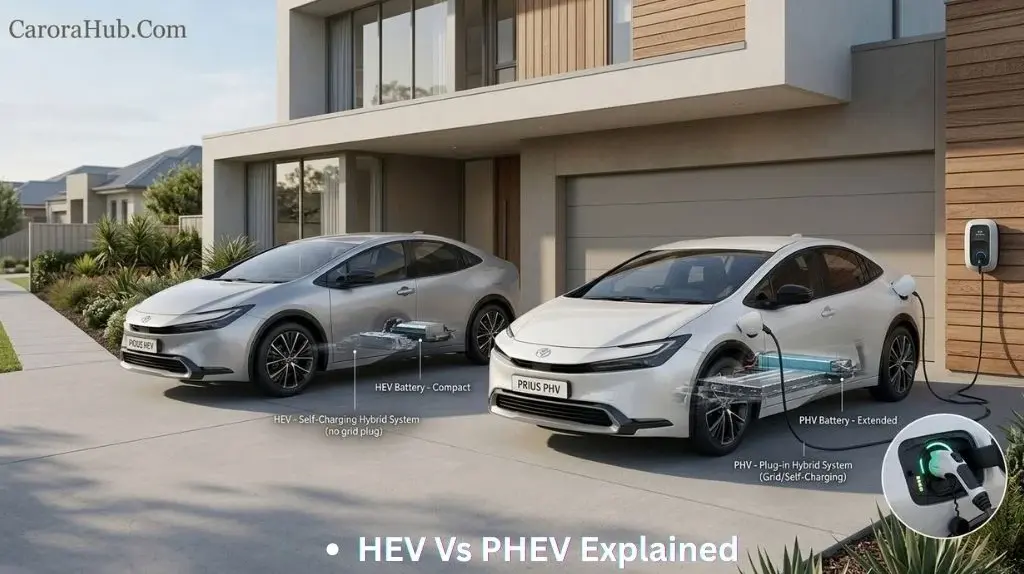
Both cars combine an electric motor with a gas engine, but they manage their energy differently. The standard hybrid carries a compact battery that captures waste energy when you brake. You can’t plug it in, and it only moves the car under pure electric power for short bursts at low speeds.
The plug-in hybrid (PHEV), sold as the Prius Prime, holds a much larger lithium-ion battery. You connect it to an electrical outlet at home or work to fill that pack with grid power. Once full, it acts like an electric vehicle until the pack runs low, then it automatically fires up the gas engine and runs like a regular hybrid.
| Feature | Standard Prius Hybrid | Prius Prime Plug-in Hybrid |
|---|---|---|
| Starting MSRP (approx.) | ~$28,000 | ~$33,000 |
| Battery Capacity | 0.9 kWh | 13.6 kWh |
| Electric-Only Range | Under 1 mile | Up to 44 miles (SE trim) |
| Total Horsepower | 194 to 196 hp | 220 hp |
| Plugs into Wall | No | Yes |
| Fuel Economy (Gas only) | Up to 57 MPG combined | Up to 52 MPG combined |
How the Standard Hybrid Prius Operates
The standard Prius balances power automatically between its 2.0-liter engine and electric motors. You put gas in the tank and drive it like any normal car.
Self-Charging Battery Mechanics
The car never needs an outside power source. When you ease off the accelerator or step on the brake pedal, the car turns the electric motor into a generator. This process, called regenerative braking, captures kinetic energy that traditional brakes waste as heat, storing it directly into the 0.9 kWh battery.
Fuel Efficiency and Daily Driving Benefits
City driving provides the biggest fuel savings because stop-and-go traffic constantly recharges the pack. The electric motor handles starting from a full stop, which saves fuel during high-load moments. Long highway trips still return over 50 MPG because the gas engine runs on an efficient Atkinson cycle, shutting down entirely when coasting downhill.
Understanding the Toyota Prius Prime Plug-in Hybrid
The Prius Prime takes the hybrid setup and adds a heavy-duty battery pack under the rear seats. It lets you cover everyday errands without burning a drop of fuel.
Electric-Only Range Capabilities
On a full charge, the base SE model delivers up to 44 miles of driving purely on electric power, according to official ratings hosted on the fueleconomy.gov Prius Prime page. Higher trims with larger wheels get about 39 miles. Once that battery reaches its floor, the car switches seamlessly into standard hybrid mode.
Charging Requirements and Infrastructure
You don’t need special home equipment to charge the Prius Prime. The included Level 1 charging cable plugs into any three-prong 120-volt wall outlet and refills the battery in roughly 11 hours. If you install a 240-volt Level 2 home charger, that time drops to about 4 hours.
Comparing Real-World Ownership Costs
Buying a plug-in hybrid brings a trade-off: you pay a higher upfront cost to save money on fuel over several years.
Maintenance and Long-Term Reliability
Both setups share identical gas engines, transmissions, and mechanical parts. Oil change schedules and brake wear remain nearly identical, though both cars go roughly 100,000 miles on original brake pads thanks to regenerative stopping. However, the Prime carries onboard chargers and battery cooling pumps that add minor mechanical complexity down the line.
Impact of Driving Habits on Fuel Savings
Your daily routine decides whether the Prime saves you money. A common mistake people make is buying the plug-in model without reliable home charging. If you run the Prime purely on gasoline, you actually get lower fuel economy than the standard Prius (52 MPG vs 57 MPG) because you’re hauling 300 pounds of dead battery weight, which costs you hundreds of dollars in wasted gas over the vehicle’s life.
Choosing the Right Model for Your Lifestyle
Here is the basic decision rule: if you can plug a car into a standard wall outlet every night and drive under 40 miles round-trip to work, get the Prius Prime. If you live in an apartment without chargers, or regularly drive hundreds of highway miles a day, get the standard hybrid.
This plug-in model isn’t for street parkers who rely on commercial public chargers. Public Level 2 stations often charge hourly rates that end up costing more per mile than simple gasoline. Your actual electric driving cost varies directly based on local utility rates, which you can read directly off your monthly electric bill.
FAQs Of Toyota Prius Hybrid vs Plug-in Hybrid Explained
Can I drive a plug-in hybrid if I can’t charge it at home?
Yes. The car functions perfectly well as a standard hybrid even if you never plug it in. However, you’ll miss out on the electric-only savings that justify its higher purchase price.
Does the plug-in model have more horsepower than the standard hybrid?
Yes. The Prius Prime produces 220 combined horsepower, while the front-wheel-drive standard hybrid produces 194 horsepower. This gives the plug-in model noticeably quicker acceleration from a standstill.
How does extreme cold weather affect the electric range of a plug-in hybrid?
Freezing winter temperatures reduce electric driving range by 20% to 35%. Chemical reactions inside the battery slow down in the cold, and using the cabin heater draws extra power directly from the battery pack.
Do both models qualify for the same tax incentives?
Neither model qualifies for the $7,500 federal clean vehicle tax credit for purchases because both are assembled outside North America. However, the Prius Prime may qualify for specific state rebates or clean vehicle lease incentives depending on where you live.
Conclusion
If you have an outlet near your parking spot, the plug-in model turns most workweeks entirely electric while keeping road trip freedom intact. For everyone else, the standard hybrid remains the simpler, cheaper way to drive 55 miles on a single gallon of gas.

I am Julian Drive, an automotive enthusiast and repair expert with over 7 years of hands-on experience in vehicle maintenance. At Carora Hub, I simplify complex car issues into easy-to-follow DIY guides to help drivers stay safe and save on repair costs.