For drivers in the United States, a well-maintained Toyota Prius can last as long as or longer than many conventional gasoline cars. A Prius engine often reaches 200,000 miles or more, while some Prius vehicles pass 300,000 miles with careful service. A conventional gasoline engine can also reach 200,000 miles, but results vary widely by vehicle, engine design, driving habits, and maintenance.
The key difference is not only the engine. A Prius has a gasoline engine, electric motor-generators, a high-voltage battery, and a hybrid transaxle. These parts share the work. That can reduce engine wear, but it adds other parts that may need repair later.
For most U.S. buyers, the best choice depends on the car’s age, service records, battery condition, repair costs, and driving needs—not on the engine type alone.
Quick answer: Does a Prius engine last longer than a regular car engine?
A Prius engine can last longer in real-world use, but Toyota does not promise that every Prius engine will outlast every conventional engine.
The Prius has several design features that may reduce gasoline-engine stress:
- The engine can shut off while the car is stopped or moving at low load.
- The electric motor helps during launch and hard acceleration.
- Regenerative braking reduces friction-brake use.
- The gasoline engine often runs at a steady, efficient load.
- The hybrid transmission has fewer traditional wear parts than many automatic transmissions.
A conventional car may have a simpler powertrain. It does not have a large traction battery or hybrid motor-generators. However, its engine may run during every trip and may face more stop-and-go stress.
Typical mileage ranges
These ranges are practical estimates, not guarantees:
| Vehicle type | Common high-mileage range | Main factors |
|---|---|---|
| Well-maintained conventional car | 150,000–250,000 miles | Engine design, oil changes, cooling system, transmission care |
| Well-maintained Toyota Prius | 200,000–300,000 miles | Battery health, cooling-system care, oil use, hybrid service |
| Neglected vehicle of either type | Often below 150,000 miles | Missed service, overheating, poor repairs, severe use |
These figures describe the vehicle’s useful service life. They do not mean the original engine, battery, transmission, and other major parts will all last for the same number of miles.
What “engine lifespan” really means
Engine lifespan can mean several different things. A vehicle may remain useful even after one major component needs repair or replacement.
Four useful ways to measure lifespan
- Engine life: How long the engine runs before a rebuild or replacement.
- Powertrain life: How long the engine, transmission, motor, and related systems work together.
- Vehicle life: How long the car remains safe and affordable to operate.
- Economic life: How long repairs cost less than replacing the vehicle.
A Prius may have a healthy gasoline engine but need a hybrid battery. A conventional car may have a strong engine but need a transmission, catalytic converter, or rust repair.
This is why mileage alone is a weak buying guide. A 180,000-mile Prius with full records may be a better purchase than a 120,000-mile car with poor service history.
The Prius gasoline engine
Most modern Prius models use a small four-cylinder gasoline engine designed for efficiency. The engine works with electric motor-generators through Toyota’s power-split hybrid system.
The engine may stop often. It may also start and stop more frequently than an engine in a conventional car. That sounds harsh, but the system controls engine temperature, fuel delivery, and oil flow to manage this operation.
The engine still needs normal care. It can suffer from:
- Low oil level
- Carbon buildup
- Cooling-system failure
- Head-gasket failure
- Worn spark plugs
- Water-pump problems
- Leaking seals
- Poor repairs after overheating
A hybrid system does not make the engine immune to wear.
The conventional gasoline engine
A conventional car sends engine power through a manual or automatic transmission. The engine usually runs whenever the vehicle moves, although some modern cars also use stop-start systems.
Conventional engines can be very durable. Many reach 200,000 miles when owners change oil on time and fix cooling or warning-light problems early.
Their risks include:
- Frequent idling
- Heavy stop-and-go driving
- Long cold starts
- Turbocharger wear on turbocharged models
- Automatic transmission failure
- Timing-chain or timing-belt problems
- Overheating
- Low oil caused by leaks or consumption
The engine type matters, but the exact vehicle matters more.
Why a Prius may reduce gasoline-engine wear
The Prius does not remove engine wear. It changes when and how the engine works.
Electric assistance lowers peak engine load
At low speeds, an electric motor can help move the car. This reduces the gasoline engine’s need to produce all the torque during launch.
That matters in city traffic. Starting from a stop can place a high load on a small engine. The electric motor handles part of that demand.
The engine can shut off at stops
A conventional car may run while waiting at a light or sitting in traffic. A Prius can shut off the gasoline engine when conditions allow.
Less idle time means fewer engine hours for the same number of miles. This may help reduce wear and fuel use.
Regenerative braking reduces brake wear
The Prius uses the drive motor as a generator during deceleration. This sends some energy back to the hybrid battery.
Regenerative braking does not directly extend engine life. It does reduce friction-brake use in many driving situations. That can lower brake service needs, although the brake system still requires inspection.
The hybrid transaxle has a different design
A Prius does not use a conventional stepped automatic transmission with many gear changes. Its power-split transaxle uses planetary gears and motor-generators to manage engine and wheel speed.
This design has fewer traditional shift parts. That may reduce some transmission wear. It does not mean the transaxle can never fail or that fluid service is irrelevant.
Cold starts still matter
A Prius engine can start several times during a trip. Toyota’s control system manages these starts, but short trips can still create moisture and fuel dilution in engine oil.
Drivers who take many very short trips should follow the maintenance schedule closely. A hybrid is not free from the effects of severe service.
Prius hybrid battery life versus conventional-car engine life
The high-voltage battery is the biggest lifespan concern that separates a Prius from a conventional car.
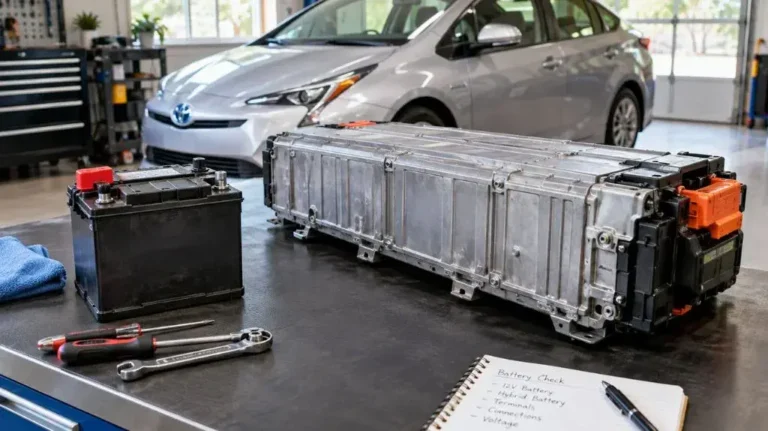
A Prius battery pack does not usually fail at one exact mileage. Some last well beyond 200,000 miles. Others lose capacity earlier because of heat, age, blocked battery cooling, long storage, or cell imbalance.
Toyota’s U.S. hybrid battery warranty has changed by model year and state. On many newer Toyota hybrids, coverage is up to 10 years or 150,000 miles, whichever comes first. Older models and non-emissions states may have shorter coverage. Check the original warranty booklet and the vehicle identification number before relying on any warranty claim.
Signs of a weak Prius battery
Possible warning signs include:
- A hybrid-system warning message
- A battery gauge that rises and falls quickly
- The gasoline engine running more than usual
- Lower fuel economy
- The cooling fan running loudly
- Reduced electric assist
- Uneven state-of-charge changes
These signs do not prove that the battery is bad. A blocked cooling vent, weak 12-volt battery, sensor problem, or other fault can produce similar symptoms.
A qualified hybrid technician should scan the vehicle and test the system before you approve a battery replacement.
Battery replacement cost
A replacement price depends on:
- Prius model and model year
- New, remanufactured, or used battery
- Labor rates
- Warranty
- Regional parts supply
- Whether the battery has a full pack warranty
Do not use one internet price as a universal estimate. Ask for a written quote that includes diagnosis, parts, labor, taxes, and warranty terms.
A Prius battery replacement may cost more than a repair on a simple gasoline car. However, a conventional car may need a transmission, turbocharger, fuel system, or emissions repair at a similar point in its life.
A battery failure does not always mean the Prius is finished
A bad battery can make a Prius unsafe or unusable until repaired. It does not mean the gasoline engine is worn out.
The correct comparison is:
Prius engine plus possible hybrid-battery repair versus conventional engine plus its own transmission and emissions repairs.
That is a more useful comparison than “hybrid or gas.”
Maintenance: the strongest predictor of long engine life
Maintenance history often matters more than the badge on the hood.
Prius maintenance priorities
For a used Prius, review these items:
- Engine oil level and oil-change records
- Engine and inverter coolant service
- Spark-plug replacement
- Brake inspection
- Hybrid-battery cooling-vent cleaning
- 12-volt battery condition
- Transaxle fluid history
- Tire condition and alignment
- Recall completion
- Warning-light history
Toyota’s maintenance guide is the controlling source for service intervals. Intervals can differ by model year, mileage, driving conditions, and region.
A Prius owner should not ignore the small 12-volt battery. It does not propel the car, but a weak 12-volt battery can cause starting problems, warning messages, and strange electrical behavior.
Conventional-car maintenance priorities
For a conventional car, check:
- Oil-change records
- Coolant service
- Transmission-fluid service
- Timing-belt replacement, if used
- Spark-plug service
- Brake and suspension work
- Turbocharger service, if equipped
- Cooling-system repairs
- Oil leaks and oil consumption
- Recall completion
A timing belt that has not been replaced on schedule can cause major engine damage on some engines. A timing chain can also wear, even though many chains do not have a routine replacement interval.
Oil level matters more than many owners think
Low oil can damage either type of gasoline engine. Older Prius engines may consume oil between services. Check the level at the interval stated in the owner’s manual, or more often if the engine uses oil.
If the oil warning light turns on while driving, stop safely and follow the manual’s instructions. Do not assume the light is a routine service reminder.
Driving conditions that change the result
The same Prius can have very different wear depending on how it is used.
City driving
City driving often favors a Prius. The hybrid system can recover braking energy and shut off the gasoline engine at stops.
A conventional car may experience more idle time and more brake wear in the same setting.
Highway driving
Highway driving can still suit a Prius, but the fuel-saving advantage may be smaller than in city traffic. The gasoline engine may run for most of the trip.
A conventional car with a durable engine may be just as practical for long highway miles. High-speed driving can raise wear on tires, cooling systems, transmissions, and suspension parts in either vehicle.
Extreme heat
Heat is hard on batteries, rubber parts, fluids, and electronics. Keep the Prius battery air intake clear. Do not place cargo, clothing, or pet hair over the vent.
In hot areas of the United States, inspect the battery cooling path and follow the service schedule closely.
Long storage
A vehicle that sits for months can develop a weak 12-volt battery, flat spots in tires, stale fuel, and brake corrosion. A Prius also has a high-voltage battery that should not be ignored during long storage.
Follow the owner’s manual for storage. Do not attempt to service high-voltage parts without proper training and equipment.
Used Prius versus used conventional car: a practical decision method
Use the following process before buying either vehicle.
1. Start with records, not the odometer
Look for dated invoices, service entries, inspection reports, and proof of recall work. A high-mileage car with consistent care may be a lower-risk choice than a low-mileage car with missing records.
2. Get a pre-purchase inspection
Choose a shop that knows the exact vehicle. For a Prius, ask for a hybrid-system scan and battery health report. For a conventional car, ask for engine, transmission, cooling-system, and emissions checks.
A basic code reader is not enough for every hybrid diagnosis.
3. Check for major warning signs
Avoid rushing into a purchase if you find:
- Active warning lights
- Overheating evidence
- Milky or contaminated fluids
- Severe oil leaks
- Unexplained coolant loss
- Rough starting
- Strong exhaust smoke
- Hybrid battery fan noise
- Structural rust
- Flood damage
- Salvage history without expert review
4. Compare repair reserves
Set aside money for likely age-related repairs. The amount depends on the car, but the principle is simple:
- Prius: plan for hybrid battery, inverter, brake, and cooling-system work.
- Conventional car: plan for transmission, timing-system, turbocharger, emissions, and cooling-system work.
Do not buy either vehicle if one unexpected repair would make the car unaffordable.
5. Compare total ownership cost
A simple estimate is:
Total cost = purchase price + fuel + maintenance + repairs − resale value
For fuel, use your own annual miles and a realistic local fuel price.
Example:
If a Prius gets 50 mpg and a conventional car gets 30 mpg, a driver traveling 15,000 miles per year uses:
- Prius: 300 gallons
- Conventional car: 500 gallons
The Prius saves about 200 gallons per year before differences in fuel prices, maintenance, insurance, and repairs. This is a hypothetical calculation, not a promise of real-world fuel economy.
6. Consider your repair network
A Prius may be a good long-term car if you have access to a qualified hybrid shop. A conventional car may be easier to repair in a remote area with limited hybrid service.
Parts availability and labor quality can change the financial result.
Common mistakes when comparing Prius and conventional-car lifespan
Mistake 1: Treating engine life as total vehicle life
The engine is only one part of the vehicle. A car can need an expensive transmission, battery, or rust repair while its engine remains healthy.
Mistake 2: Assuming every Prius battery fails at 100,000 miles
Battery life varies. The warranty limit is not the same as the expected failure date.
Mistake 3: Assuming a conventional car has no expensive electronics
Modern gasoline cars can have turbochargers, direct-injection systems, complex transmissions, emissions controls, and costly computer modules.
Mistake 4: Ignoring the cooling system
Overheating can cause severe damage to a Prius or a conventional engine. Coolant leaks, weak pumps, blocked radiators, and neglected service deserve prompt attention.
Mistake 5: Buying based only on fuel economy
Fuel savings may not offset a poor purchase. Check the vehicle’s condition, records, accident history, battery health, and expected repairs first.
Mistake 6: Using a general mechanic who cannot test hybrid systems
Hybrid high-voltage systems can be dangerous. Do not remove battery covers, probe high-voltage cables, or attempt repairs without the correct training and protective equipment.
Which lasts longer: Prius or conventional car?
A Prius often has a strong long-term record because its hybrid system reduces engine load, idling, and friction-brake use. Many owners report very high mileage, and Toyota’s design supports long service when maintained correctly.
A conventional car can last just as long when it uses a durable engine and receives careful service. It may also be easier and less costly to repair in some areas.
Choose a Prius when:
- You drive in city or mixed traffic.
- You value fuel savings over many years.
- The vehicle has strong service records.
- A qualified hybrid shop is nearby.
- A battery repair reserve fits your budget.
Choose a conventional car when:
- You need simple repairs in a rural area.
- You drive mostly long highway miles.
- The exact engine and transmission have a strong service history.
- You prefer to avoid high-voltage battery repairs.
- The vehicle has a clear record and lower total ownership risk.
The safest conclusion is not that one powertrain always wins. A well-maintained Prius usually has excellent longevity, but condition and maintenance history should decide the individual purchase.
FAQs Of Toyota Prius Vs Conventional Car Engine Lifespan
Can a Prius last 300,000 miles?
Yes, some Prius vehicles reach 300,000 miles or more. This is possible, not guaranteed. The battery, engine, transaxle, suspension, electronics, and body may need repairs along the way.
Is a Prius engine more reliable than a regular engine?
The Prius engine can be very reliable because electric assistance reduces some engine load. Reliability still depends on the exact engine, model year, maintenance, oil level, cooling system, and driving conditions.
What is the most expensive Prius repair?
A hybrid battery, inverter, engine repair, or transaxle can be expensive. The cost depends on the model year, parts choice, labor, and local rates. Obtain a diagnosis and written estimate before choosing a repair.
Should I avoid a Prius with over 150,000 miles?
Not automatically. Check battery health, service records, oil consumption, cooling systems, accident history, and rust. A documented 180,000-mile Prius may be safer than a neglected 100,000-mile example.
Do Priuses need oil changes?
Yes. The gasoline engine still needs the correct oil and filter at the intervals listed in the owner’s manual. Hybrid operation does not remove the need for engine lubrication.
Final takeaway
A Toyota Prius and a conventional gasoline car can both last beyond 200,000 miles. The Prius may have an advantage in stop-and-go use because electric assistance and regenerative braking reduce some engine and brake work. Its trade-off is a more complex powertrain and a future hybrid-battery risk.
For a new or used vehicle in the United States, judge lifespan by the full system:
- Service records
- Engine condition
- Battery health
- Cooling-system condition
- Transmission or transaxle condition
- Repair costs
- Driving pattern
- Local service support
Before buying, arrange a model-specific inspection. For a Prius, include a hybrid battery and system scan. For a conventional car, include engine, transmission, cooling, and emissions checks. That step tells you far more than the odometer alone.
Sources for further checking
- Toyota Owners: Maintenance and warranty information
- Toyota U.S. warranty coverage
- U.S. Department of Energy: Hybrid electric vehicles
- U.S. EPA: Vehicle maintenance
- National Highway Traffic Safety Administration: Recalls

I am Julian Drive, an automotive enthusiast and repair expert with over 7 years of hands-on experience in vehicle maintenance. At Carora Hub, I simplify complex car issues into easy-to-follow DIY guides to help drivers stay safe and save on repair costs.