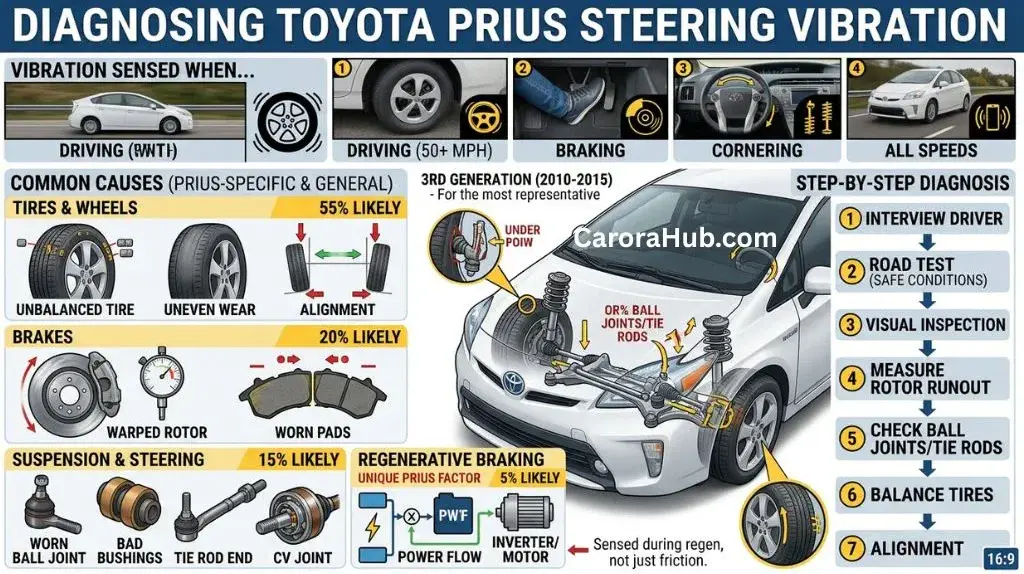
You can diagnose Toyota Prius steering vibration by matching the symptom’s timing to its source: highway shaking points to unbalanced tires, wobbling under braking indicates uneven brake rotors, and vibration during throttle points to worn inner CV axles. Finding the source early keeps a minor alignment or balance issue from turning into expensive steering damage.
Common Causes of Steering Vibration in a Toyota Prius
A Prius shares standard mechanical parts with other front-wheel-drive cars, but its hybrid system adds specific quirks. The car runs very quietly in electric mode, so physical vibrations often feel much louder and harsher to the driver than they would in a standard gas car.
The table below outlines the most frequent culprits, when they show up, and how to tell them apart:
| Component | Shaking Trigger | Typical Speed Range | Other Symptoms |
|---|---|---|---|
| Front Wheels | Constant cruising | 50 to 70 mph | Steering wheel twitches side-to-side |
| Brake Rotors | Pressing the brake pedal | Any speed during slowing | Pulsing in the brake pedal |
| Inner CV Axle | Stepping on the gas | 30 to 55 mph under load | Shaking stops when you coast |
| Wheel Bearing | Constant driving, worse in turns | 25 mph and up | Low humming or grinding roar |
| Suspension Bushings | Bumps, rough pavement, braking | Variable | Loose steering, car wanders |
Here is a simple decision rule to narrow down the problem quickly: if the steering wheel shakes only while your foot is on the brake pedal, inspect the front brake discs; if it shakes only while pressing the gas pedal, inspect the driveshafts; if it shakes constantly at freeway speeds without touching either pedal, check your wheel balance.
Evaluating Tire and Wheel Condition
Tires cause most highway-speed vibrations. Because the Prius uses low-rolling-resistance tires with stiff sidewalls, small balance errors pass straight into the cabin.
Checking for Uneven Tire Wear
Run your bare hand along the tire tread across its width and around its circumference. The surface should feel smooth in both directions. If you feel raised block edges that catch your fingers one way—known as cupping or heel-toe wear—the shock absorbers or rear suspension bushings are likely worn out. If the inner edge has worn down to smooth rubber while the outer edge still shows deep tread, your wheel alignment is off.
Tread wear varies by model and tire brand, so check the tire sidewall for treadwear indicators. Driving on misaligned wheels is a common mistake that costs drivers hundreds of dollars in ruined tires within just a few thousand miles.
Identifying Bent Rims or Balance Issues
Factory Prius alloy rims are relatively soft to save weight, making them prone to bending if you hit a deep pothole. Look closely at the inner and outer metal lips of the wheel for flat spots or cracks.
If the rim looks round, balance is your next check. Adhesive wheel weights can fly off over time. An unbalanced wheel shows up as a rhythmic vibration between 55 mph and 65 mph. The trade-off between standard static balancing and road-force balancing is cost versus accuracy: road-force balancing costs more at a tire shop, but it catches internal tire stiff spots that normal spin balancers miss completely.
Inspecting Suspension and Steering Components
A worn chassis part lets the front wheels wobble freely instead of staying pointed straight ahead.
Testing Tie Rod Ends for Play
Raise the front of the car safely with a floor jack and set it securely on two jack stands. Grab one front tire firmly with your hands at the 9 o’clock and 3 o’clock positions. Push with your left hand while pulling with your right, wiggling the tire back and forth.
You should feel zero free play. If you feel a distinct click or physical slop before the steering wheel moves, look directly behind the wheel hub at the outer tie rod end. If the ball stud shifts inside its socket, the tie rod end is worn out and needs replacement.
Checking Control Arm Bushings
The lower control arms keep your front wheels centered in the wheel wells. Shine a flashlight behind the wheel at the large round rubber bushing on the rear of the arm. Look for deep cracks, tearing, or rubber pulling away from the steel sleeve. If this rubber fails, the control arm shifts backward every time you hit the brakes, causing the steering wheel to yank to the side and shudder.
Brake System Malfunctions and Rotor Warping
Prius models use regenerative braking to slow down using the electric motor, which means the mechanical friction brakes are used much less than in conventional cars. Because the mechanical pads and rotors sit unused during gentle stops, moisture often builds up rust spots on the iron rotors.
When you finally stop hard, the brake pads skip over these rusty or uneven patches. This variation in disc thickness causes brake torque variation, which shakes the front calipers and travels up through the steering rack. If the steering wheel shakes only while slowing down, resurfacing or replacing the front rotors usually solves it.
Electric Power Steering System Diagnostics
The Toyota Prius uses an electric motor mounted directly to the steering column rather than a hydraulic fluid pump. This system has no power steering fluid to check or leak.
Instead, a torque sensor inside the steering column reads how hard you pull the wheel and sends that signal to the Power Steering computer. If the steering feels notchy, jerks erratically around center, or gives an uneven vibration during low-speed turns, the system may have an electrical issue. Check your dashboard for a red or yellow warning light showing an icon of a steering wheel with an exclamation mark. Scanning the car with an OBD-II scanner capable of reading Toyota chassis codes will tell you if the torque sensor or electric motor has logged a fault code.
Drivetrain and Axle Considerations
The front axle half-shafts transfer motor power from the transaxle out to the front hubs. When they wear down, they create distinct physical feedback in the cabin.
Signs of a Failing CV Joint
Each axle has an outer constant-velocity (CV) joint near the wheel and an inner joint near the transmission. A failing outer CV joint usually clicks loudly while making tight parking-lot turns.
An inner CV joint fails differently. The three rollers inside the inner tulip housing wear deep grooves into the metal track over time. Under engine load—such as accelerating up a highway on-ramp or climbing a hill—the axle binds in these grooves and violently shakes the car from side to side. The moment you take your foot off the gas pedal, the shaking disappears completely. If you experience vibration only while pressing the throttle, the inner CV axle joints are the primary suspect.
Step-by-Step Troubleshooting Procedure
This procedure is designed for a home garage using standard hand tools. This troubleshooting guide isn’t for people who lack a level concrete workspace, a hydraulic floor jack, and sturdy jack stands, as crawling under an improperly supported car is dangerous.
- Check cold tire pressure: Use an accurate digital gauge on all four tires before driving in the morning. Inflate them to the pressure listed on the driver door jamb sticker (typically 35 psi front, 33 psi rear for standard 15-inch Prius wheels; adjust according to your specific door sticker).
- Take an observational test drive: Drive the car on a smooth, empty road. Note the exact speed the vibration starts, whether it happens during cruising, braking, or accelerating, and whether it shakes the steering wheel (front axle) or your seat (rear axle).
- Inspect wheels for debris: Park the car, turn it off, and inspect the inside barrels of the front rims. Knock off any dried mud, packed snow, or road tar using a stiff nylon brush.
- Lift the front end: Engage the parking brake, block the rear wheels with wheel chocks, lift the front of the vehicle, and rest the frame rails solidly on jack stands.
- Perform the wheel shake test: Grip each front tire at 9 and 3 o’clock and wiggle it horizontally to check the tie rods. Then grip the tire at 12 and 6 o’clock and wiggle it vertically to check the wheel bearings and lower ball joints.
- Spin the tires by hand: Spin each front tire while holding onto the suspension spring with your other hand. If you feel a rough vibration through the spring coils as the tire spins, the wheel bearing is failing.
- Visually inspect rubber boots: Look behind the wheel hub for torn, grease-covered rubber boots on the drive axles, tie rods, and steering rack. Torn boots mean road grit has entered the joint.
- Know when to stop: If your suspension joints pass the physical shake test and your tire pressures are correct, stop there. Finding internal tire separation, checking axle runout, or measuring brake rotor thickness with a micrometer requires professional shop equipment. Take the car to an ASE-certified mechanic or tire specialist.
FAQs About Diagnose Toyota Prius Steering Vibration
Can low tire pressure cause steering wheel shaking at high speeds?
Low tire pressure alone usually causes sluggish handling, poor fuel economy, and tire squeal rather than a rapid vibration. However, running a tire significantly under-inflated causes the tread to flex unevenly and build up excess heat, which can make an existing wheel balance problem feel far worse on the highway.
Does regenerative braking affect steering vibration diagnostics?
Yes. During light braking above 10 mph, the Prius slows down primarily by using its electric motor-generator, so the brake pads barely touch the rotors. If a brake rotor has uneven spots, you’ll often feel the pulsing through the steering wheel only when you push the pedal harder, forcing the hydraulic friction pads to clamp firmly onto the discs.
When should I replace my wheel bearings if I feel vibration?
Replace a wheel bearing the moment you can feel physical movement when shaking the tire vertically at the 12 and 6 o’clock positions, or when the bearing begins growling loudly. A worn wheel bearing allows the wheel hub to wobble slightly on the spindle, creating both a steering shudder and uneven brake pad wear.
Is it safe to drive a Prius with persistent steering vibration?
It isn’t safe to ignore persistent steering vibration. While a small wheel balance weight loss is simply annoying, vibrations caused by a loose tie rod, failing lower ball joint, or separated tire tread can cause a complete loss of steering control or a tire blowout at highway speeds. Have the vehicle inspected promptly to confirm the cause.
Final Thoughts
If you aren’t comfortable performing these checks yourself, don’t hesitate to visit a trusted mechanic. They’ll quickly pinpoint the exact cause so you can get back to a smooth, quiet ride. It’s better to fix these small issues today, as your car’s safety shouldn’t be left to chance.

I am Julian Drive, an automotive enthusiast and repair expert with over 7 years of hands-on experience in vehicle maintenance. At Carora Hub, I simplify complex car issues into easy-to-follow DIY guides to help drivers stay safe and save on repair costs.